Free climbing history ... The history of free climbing is relatively recent, at the beginning of 1900 Paul Preuss was among the first to give greater importance to the style of ascent to reach the top rather than climbing. In the '50s the American John Gill introduced the basic technical climbing, using the chalk to improve the grip. In short, the climbing is popular in the United States of America and Europe, finding a broad consensus among climbers classics. The climbing is practiced on mountain slopes, mainly on granite walls and cliffs. This is the philosophy of free climbing climb without help with the guards to progress, but does not renounce the existence risk and adventure, the two concepts has always been his climbing. The climbing instead removes the risk from its interpretation, centering attention on every performance. The playing field may be the same as in the case of the cliff, but changed the face of the game: climb to protecting friends, for instance, free climbing, as well as in free climbing in montagna.Quasi a century ago Preuss theorize 'l 'rock climbing at its most' pure, even claiming that they had to go only where it would have been able to get off. Preuss was a fundamentalist in one piece, also a supporter of climbing without a rope, and his death was commented with some irony by most of his contemporaries, believed that the rise was more important than style to climb.
Free climbing history ... The history of free climbing is relatively recent, at the beginning of 1900 Paul Preuss was among the first to give greater importance to the style of ascent to reach the top rather than climbing. In the '50s the American John Gill introduced the basic technical climbing, using the chalk to improve the grip. In short, the climbing is popular in the United States of America and Europe, finding a broad consensus among climbers classics. The climbing is practiced on mountain slopes, mainly on granite walls and cliffs. This is the philosophy of free climbing climb without help with the guards to progress, but does not renounce the existence risk and adventure, the two concepts has always been his climbing. The climbing instead removes the risk from its interpretation, centering attention on every performance. The playing field may be the same as in the case of the cliff, but changed the face of the game: climb to protecting friends, for instance, free climbing, as well as in free climbing in montagna.Quasi a century ago Preuss theorize 'l 'rock climbing at its most' pure, even claiming that they had to go only where it would have been able to get off. Preuss was a fundamentalist in one piece, also a supporter of climbing without a rope, and his death was commented with some irony by most of his contemporaries, believed that the rise was more important than style to climb.
FLORENCE Florence's origins date back 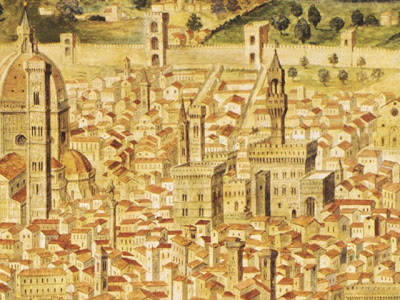 Etruscan when some residents of Fiesole hill over the valley of the Arno, and went down the valley and built a new settlement. In Roman times the town was called "Florentia", that is "destined to flourish." Since the first century BC, this Roman town began to develop, to quickly purchase a pre-eminent position among the cities of Tuscia, and his final breakthrough culminated three centuries later, in the second century AD.
Florence after the Middle Ages, a time of economic stagnation for the whole of Europe, had a remarkable development at the time of the Carolingian emperors established itself as one of the most important centers of the Italian peninsula from the cultural point of view. He was first a fief of the Marquises of Tuscany and by 'XI century the city gained increasing autonomy in 1115, at the end of the fight against simony and clerical lords of the countryside, the city became a free city. Soon the city began to emerge first contrast between the urbanized and the feudal class in artisan collection of craft guilds or corporations. The conflict resulted in the two factions of the Guelphs, parteggianti for the Pope and the Ghibellines in favor of the imperial cause. Despite the struggles, Florence managed to win in the fight against Pistoia, Arezzo, Volterra and Siena, thereby enlarging its territory. Between the end of the thirteenth and early fourteenth century, the city established itself as one of the most important centers of Italy thanks to the bankers, the flourishing of the Arts of wool and silk and the presence of artists such as Giotto and Dante Alighieri . In 1348 the city went through a difficult period due to the spread of the plague that killed hundreds of people, caused a moral degradation and caused a deep crisis in the economy. At the end of '300 is verificarono lotte civile tra il popolo grasso , ossia la ricca borghesia che aveva nelle sue mani le sorti dello Stato tramite le Arti maggiori, e il popolo minuto. La rivolta dei Ciompi (i cardatori della lana) del 1372 portò ad un ribaltamento del governo ed all’ascesa del popolo minuto al potere. Intanto cominciò ad affermarsi il prestigio della famiglia dei Medici che in breve s’insignorì della città con Cosimo il Vecchio. Nella famiglia medicea, amata dai fiorentini per il suo mecenatismo e per la sua liberalità, si distinsero diverse figure fra le quali spicca Lorenzo de’Medici, detto il Magnifico, che consentì a Firenze di ottenere un prestigio in tutta l’Europa nell’ambito culturale, artistico ed economico. Fino alla sua morte (1492) svolse un’intensa opera di mediazione tra i vari Stati italiani sempre in lotta tra loro e garantì al Paese un periodo di prosperità economica per cui fu definito l’ago della bilancia. Il Cinquecento vide Firenze trasformarsi con fasi alterne in Repubblica, Nel 1537 però ritornarono i Medici al potere in quanto poterono contare sull’appoggio dell’Imperatore e del Papa. Nel 1569 la città divenne un granducato con Cosimo de’ Medici. Nei secoli successivi la città fu retta dai Lorena. Dopo la parentesi napoleonica (1799-1814) Firenze partecipò alle guerre d’indipendenza fino alla definitiva annessione all’Italia. Fu capitale d’Italia dal 1865 al 1871.


